Why Excel stops keeping up
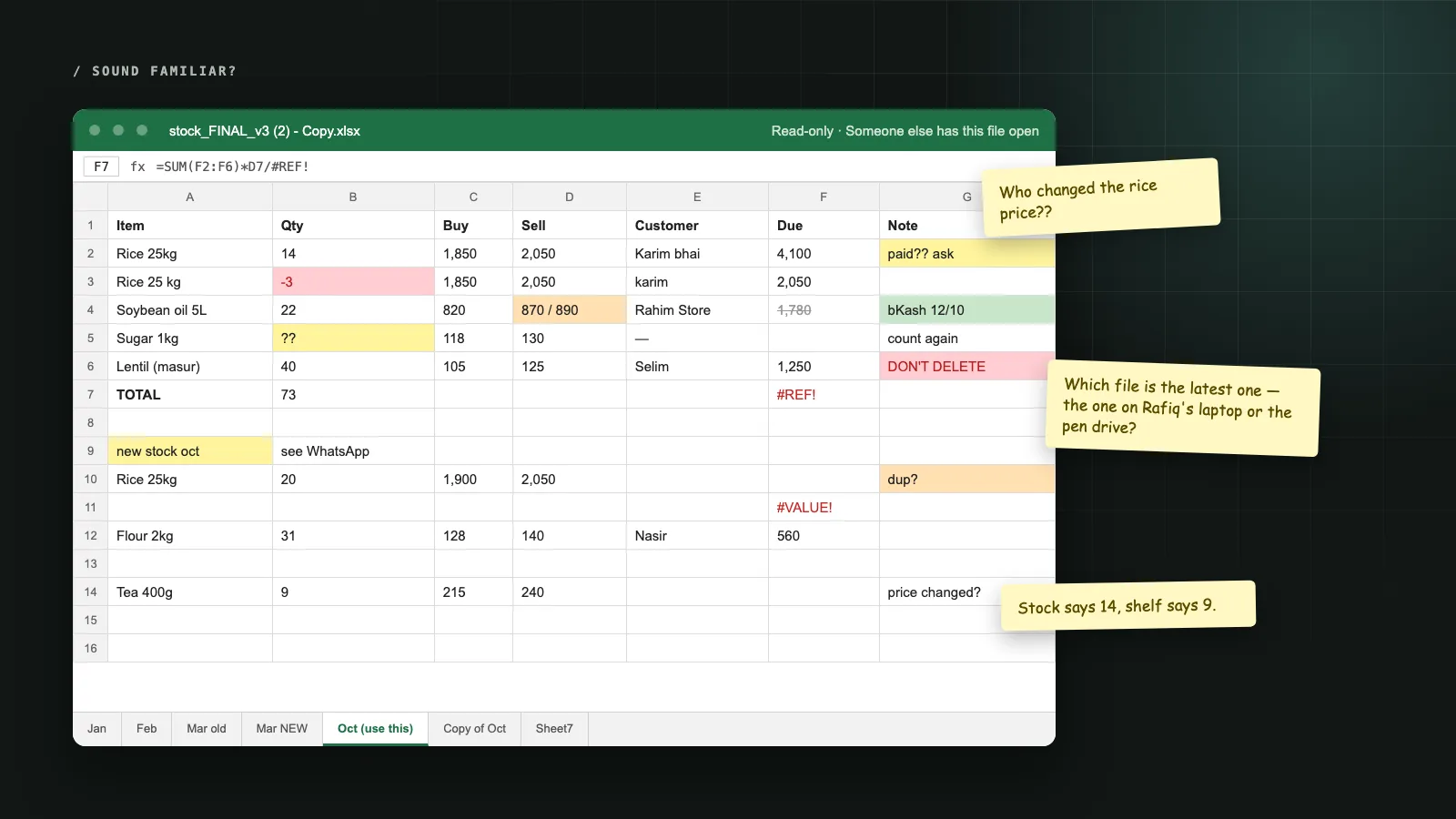
Excel is built for one person at one desk. As the business grows, the counter, the godown and the accounts person all open the same file. Someone copies it to their laptop, someone sends it on WhatsApp, and within two days there are three different "latest" files.
Excel never stops anyone typing a mistake. Negative stock, the same customer spelled three ways, a broken formula: all of it goes in quietly. And there is no record of who changed which number.
Signs your sheet has outgrown you
If more than three of these sound familiar, the sheet is now slowing the business down.
- Files called FINAL, FINAL_v2 and Copy of FINAL, and nobody sure which one is right
- Two people open the file at once and one person’s work disappears
- Totals suddenly show #REF! or #VALUE!
- Stock in the sheet never matches stock on the shelf
- Staff can see cost prices and profit, because it is all one file
- One dead laptop away from losing months of records
What the sheet costs, in taka
Excel feels free, but time and mistakes have a price. Take one example:
- A staff member on ৳15,000 a month, 26 working days, 8 hours a day: about ৳72 an hour
- They spend an hour and a half a day merging copies and checking totals: about ৳108 a day
- Over 26 days, about ৳2,800 a month just keeping the sheet straight
- Add one forgotten due, say ৳4,100, lost between two copies of the file
- Total: about ৳6,900 a month that never shows up on any bill
7 rules for moving from sheet to software
- Start with the sheet that hurts most, not everything at once. Usually it is dues or stock.
- Gather every file in use today, old copies too. Working out which is right is part of the move.
- Write down what each column means: is "Due" the total owed, or this month only?
- Write down the rules you keep in your head: when to reorder, how long a customer can owe.
- Decide who sees what first. Should the counter see cost prices?
- Clean and import the old data, then run both side by side for a week and match the totals.
- Make sure any list can be exported back to Excel. Your data should never be locked in.
Before and after
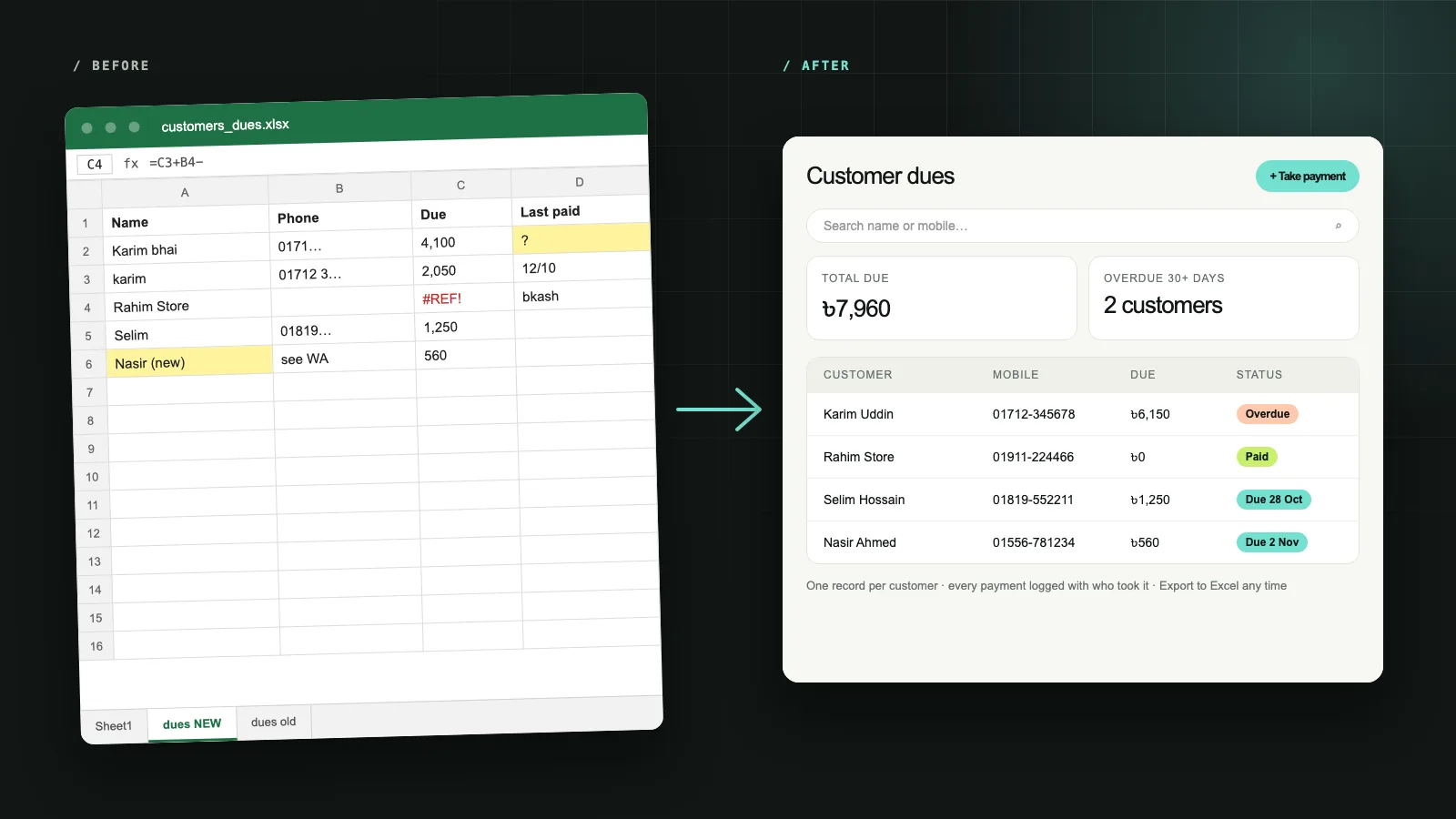
Same information, but in software each customer exists once, you find them by mobile number, and every payment records who took it. The dues guide covers how to keep credit under control.
Mistakes to avoid
- Asking for an exact copy of the spreadsheet. The point of software is to stop mistakes, not to keep every cell the same.
- Going live before the old data matches. If the totals are off in week one, the team goes back to the sheet.
- Switching without the people who type every day. Show them first.
- Choosing software you cannot get your data out of.
How Nodibyte moves you
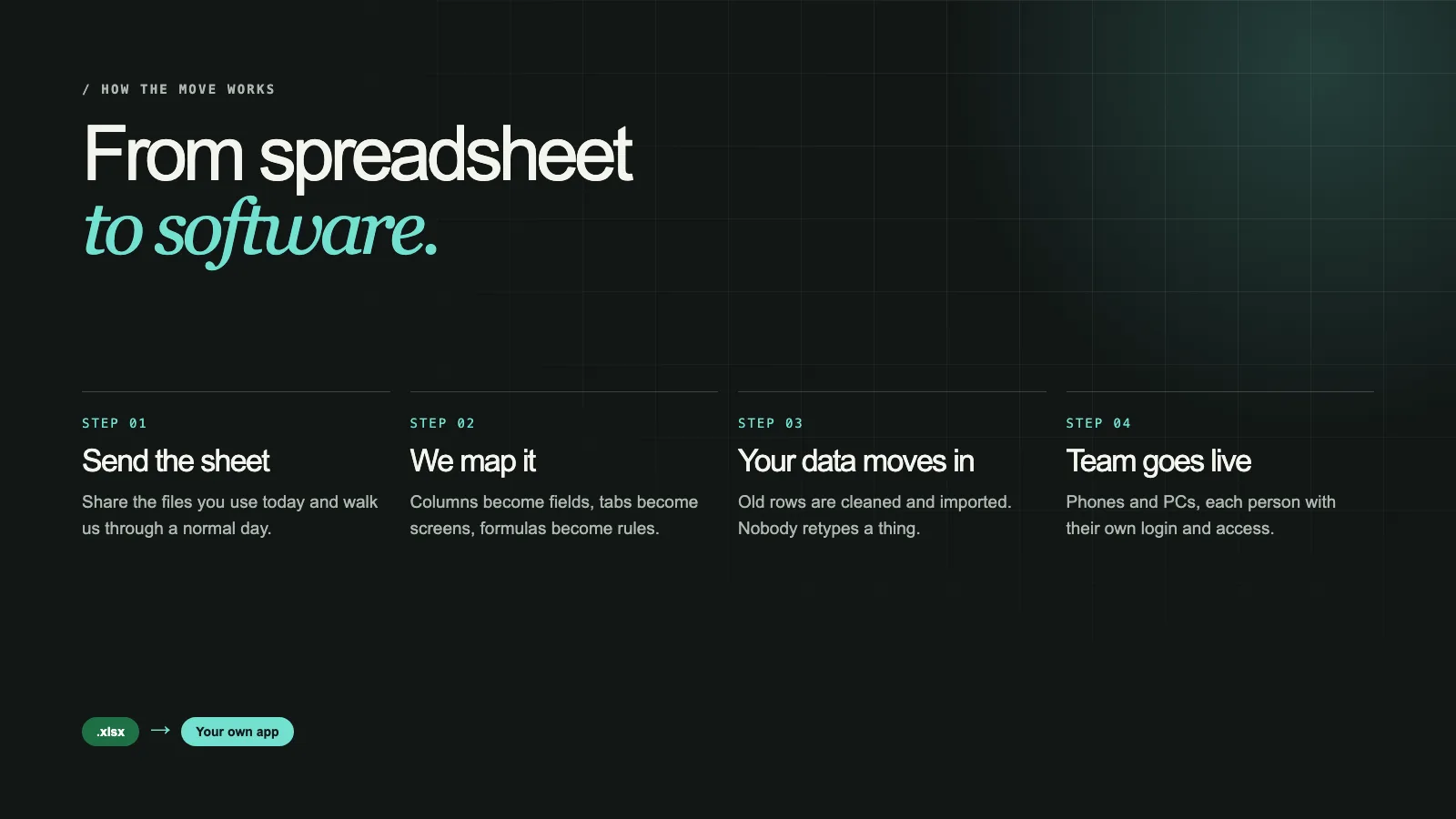
You send the sheet and show us a normal day. We turn columns into fields, tabs into screens and formulas into rules, and give you a fixed quote before we build. We clean and import your old data, then train each person on their own screen.
What you get
Running a shop, pharmacy or restaurant? You may not need a custom build: Store Management starts at ৳999 a month and already covers stock and dues.
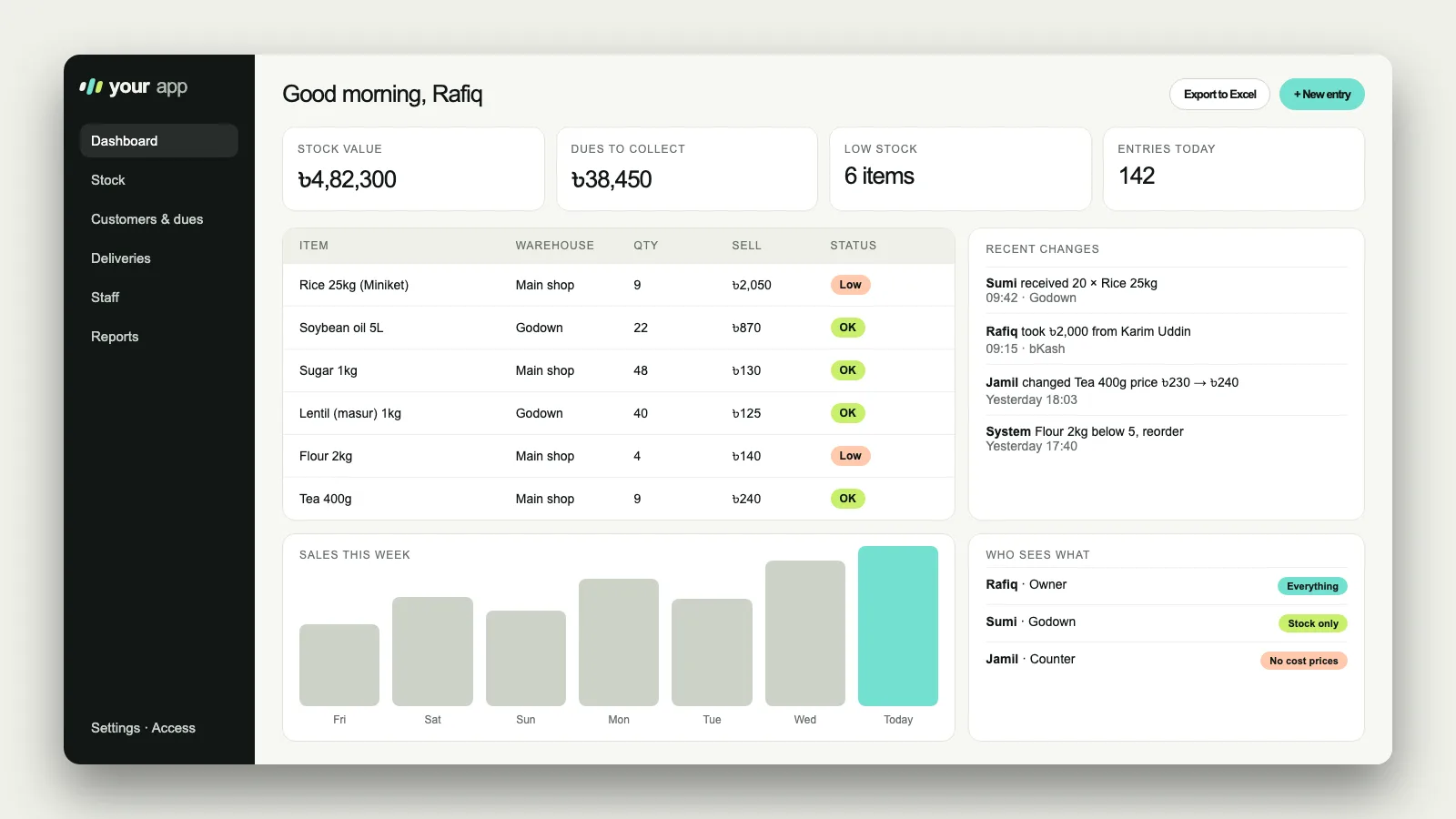
- Runs in the browser on any phone, tablet or PC, and installs like an app
- A login for every person, with permissions for what they see
- A history of every change: who, what and when
- Any list exports to Excel or CSV
- Data on a server with regular backups
How to start
Tell us what your sheet does and where it hurts on the Excel to Software page. We look at it and tell you what it becomes and what it costs, with no obligation.
Questions people ask
Will I lose my old data moving from Excel to software?
No. Your existing sheets are cleaned and imported, and the totals are matched with you before you switch.
Does a small business need software?
If one person keeps the books alone, Excel is fine. Once two or three people write to the same sheet, or the month-end totals take hours, it is time.
How much does it cost to turn Excel into software?
It depends on how much the sheet does. Nodibyte looks at it and gives a fixed quote before any work starts. Ready-made apps for shops are a monthly price.